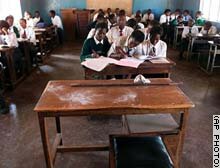
Children at a Lusaka, Zambia, elementary school do schoolwork in the absence of their teacher. More than 1 million African children lost their teacher to AIDS last year, according to UNAIDS.
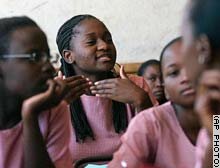
LUSAKA, Zambia (AP) -- Almost every hand in the sun-washed classroom at Kaplunga Girls High School shoots up in stark answer to a simple question: How many of you have lost a teacher to AIDS?
One lost a religion teacher. Another recalls a geography teacher who was especially nice. Others sigh about the civics teacher who died just before exam week.
As AIDS spreads across Africa, it cuts a path of devastation through every aspect of society. It crushes economies, leaves millions of children orphans and casts a cloud over the continent's future by killing its teachers.
More than 1 million African children lost a teacher to AIDS last year, according to UNAIDS, the U.N. program set up to fight the disease.
Some remote schools with only one teacher have been forced to close. In others, class sizes have surged, and underqualified, hastily trained substitute teachers have struggled to ensure students get some sort of education.
And in countries like Zambia, where one-fifth of the adults are thought to be infected with HIV, the disease is killing teachers at a rate too fast to be replaced, authorities say.
Losing leaders
Kenneth Ofusu-Barko, a UNAIDS adviser in Zambia, says the loss of teachers is felt far beyond the classroom.
Teachers "tend to be community leaders, so when they are gone they create a vacuum ... communities tend to lose their cohesion and there is an element of hopelessness," he said.
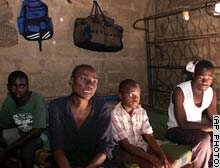
HIV-positive teacher Delphia Akafumba Mwanagala, second from left, and her three sons pose in their two-room home in Lusaka, Zambia.
In the capital, Lusaka, music teacher Remmy Mukonka helped found the Anti-AIDS Teachers Association of Zambia after watching many of his close colleagues die.
Mukonka, 31, and colleagues provide information about counseling, testing and AIDS drugs to teachers. But most of all they try to fight the stigma surrounding AIDS that makes it so difficult to talk about the disease, let alone tackle it.
Teachers say that as public figures, they find it even more challenging to discuss their condition.
At a meeting of teachers at a Lusaka elementary school, those used to standing at the blackboard take seats behind rickety wooden desks and speak about the disease that is decimating their ranks and making quality teaching all but impossible.
Every day someone is absent because of illness and can't be replaced, said Monica Chibuye, 29. "We try to distribute kids to different classes but they are already overloaded."
Some classes spill over with as many as 100 students. Teachers cover only part of the curriculum and struggle to keep up with grading students and monitoring their progress. They also must cope with new challenges of teaching in the AIDS age, such as dealing with orphaned students.
Income and insurance
With low salaries and no health insurance, HIV-positive teachers feel doomed.
If they retire for health reasons, their pensions will not go into effect for about four years, by which time they could be dead, they say.
In the front row of the classroom is Delphia Akafumba Mwanagala, a 43-year-old elementary school teacher. She is HIV-positive and has a hacking cough from tuberculosis.
"When you get sick, you waste away," said Mwanagala.
We are losing the people who are educating us. What are we going to do?
-- Andrew Mwape, 18-year-old student
One of Lusaka's few teachers to openly declare herself HIV-positive, Mwanagala said she was infected by her husband, a retired soldier. He died four years ago and his family took over the family home and all their possessions.
Now Mwanagala and her three sons, ages 9, 13 and 19, live in a two-room cinderblock shack at the end of a dirt path in Lusaka. There is no electricity, but the door is cracked open to admit a beam of sunlight.
Gaunt and exhausted, skin drawn tightly against high cheekbones, Mwanagala doubts she will have the strength to return to teaching when her three-month sick leave ends. She has no money for doctors and the dusty air worsens her cough.
Her $50 monthly salary isn't enough to live on after paying school fees, rent, transportation and food.
So she pounds aloe vera leaves to prepare something to ease her coughing, and writes notes to her fellow teachers asking for help.
"But unfortunately they also have very little salaries," she says.
Too many funerals
At Kaplunga Girls High School, girls in the schoolyard laughingly call the school by its nickname, ABC -- AIDS Breeding Center. And they talk about the disruption and sadness of having six teachers die the past two years.
Students at Kaplunga Girls High School in Lusaka, talk about how their teachers died of AIDS in Lusaka, Zambia.
School administrators said classes were canceled for teacher funerals in the past. But no longer. There are too many funerals.
At one of the school's AIDS clubs, students from the neighboring boys' school join in for meetings about safer sex and reaching out to the sick.
They exchange memories of friends and teachers who have died and are more outspoken about the disease than many adults are.
"We are losing the people who are educating us," says Andrew Mwape, 18. "What are we going to do?"



 We are losing the people who are educating us. What are we going to do?