|
Colombia
|
|
Colombia
|
|
Journal Photographs Origins Symbols Departments History Economy Geography and Climate Population, Ethnic Groups, Culture and Religion Fauna and Flora Resource Links Lesson Plans Maps Check out the Route Maps
|
Click on either map to see it in detail
|
| Origin of the name Colombia | The name Colombia has its origin in the name of the explorer Christopher Columbus. | |||
|
Symbols
|
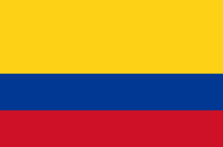
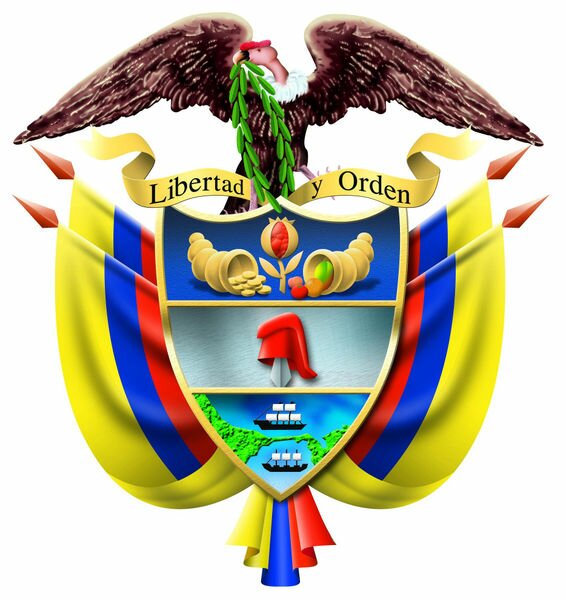
Click on each link below to learn more about the symbols.
|
|
||
|
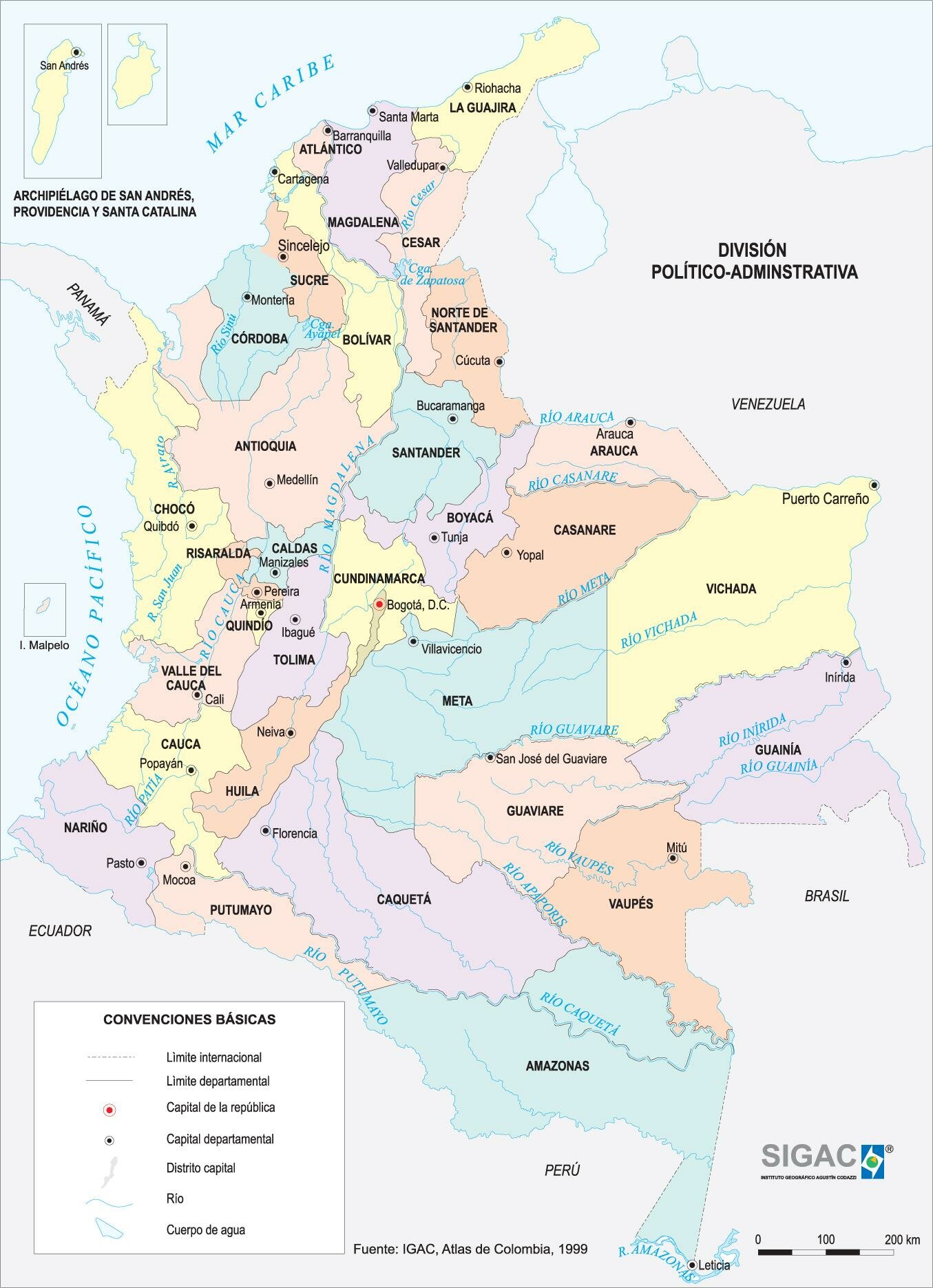
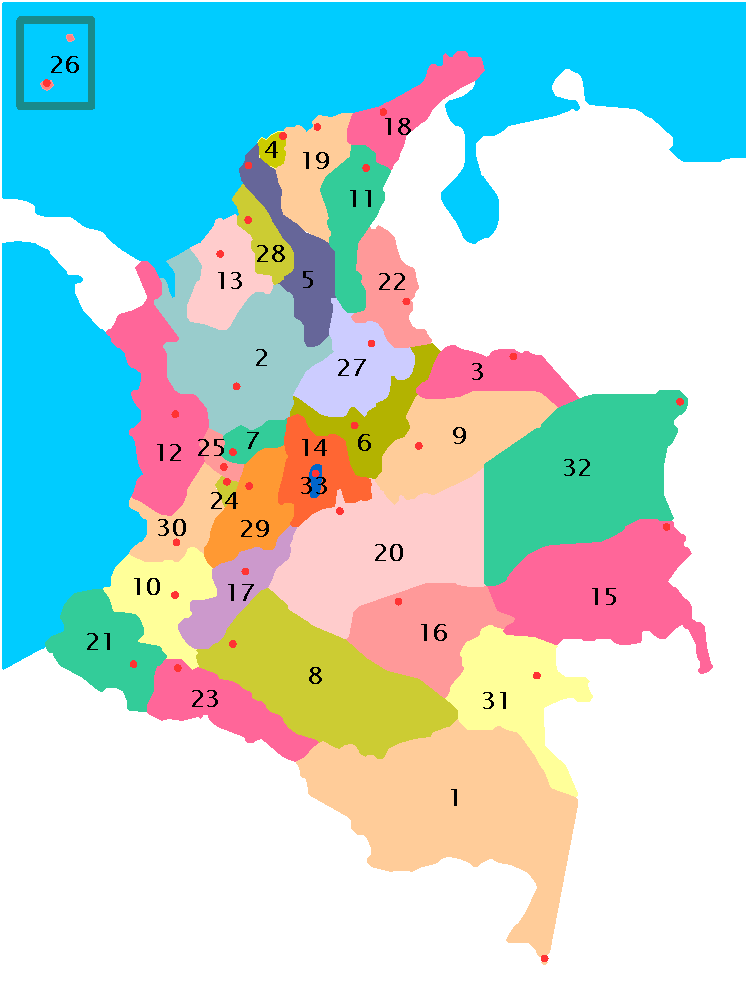
Colombia has 32 Departments
|
Departments Colombia is divided into 32 departments (departamentos) and one capital district (distrito capital). The departments (with capital city in parentheses) include:
Colombia is subdivided into municipalities (municipios), which are further subdivided into corregimientos. Source: Wikipedia the free Encyclopedia, |
|||
| Languages | Colombia has one official language: Spanish | |||
|
Colombia History
|
History There are three main archeological sites in Colombia: San Augustin, Tierradentro and Ciudad Perdida. Artifacts left behind include pottery and gold. In contrast to the Aztecs or Incas who dominated vast regions, a dozen independent Colombian groups occupied relatively small areas scattered throughout the Andean region and along the Pacific and Caribbean coasts. Included among them are the Calima, Muisca, Narino, Quimbaya, San Agustin, Sinu, Tayrona, Tierradentro, Tolima and Cumaco peoples. The first European to set foot on Colombian soil was Alonso de Ojeda in 1499. His exploration and dealings with the local Indians gave birth to the myth of El Dorado, a kingdom abundant in gold. From the moment the Spanish arrived, their obsession with El Dorado became the principal force driving them into the interior. They did not find El Dorado, but their search did result in rapid colonization. In 1550 King Carlos V of Spain established a court of justice in Bogota and brought the colony under the control of the viceroyalty of Peru. The population of the colony initially consisted of indigenous communities and Spanish invaders, but was diversified with the arrival of Blacks, brought from Africa to serve as the workforce. During the 16th and 17th centuries the Spaniards shipped in so many Africans that they eventually surpassed the indigenous population in number. With the growth of the Spanish empire in the New World, a new territory was created in 1717 and Bogota became the capital of its own viceroyalty, the Virreinato de la Nueva Granada. It comprised the territories of what are today Colombia, Panama, Ecuador and Venezuela. As Spanish domination increased, so did the discontent of the inhabitants. The first open rebellion began in 1781, as one by one, Colombian towns declared their independence. In 1812, Simon Bolivar won six battles against Spanish troops but was defeated the next year and full Colonial rule was reestablished by 1817. Bolivar retreated, but returned, strengthened with help from a British legion and claimed victory after victory. Colombia’s independence was finally won in 1819. A revolutionary congress was held that same year and a new state, Gran Colombia, was proclaimed uniting Venezuela, Colombia, Panama and Ecuador. But the vast state began to disintegrate almost from the beginning. Bolivar was far away fighting for the independence of Peru and it soon became apparent that a central regime was incapable of governing such a vast and diverse territory. So in 1849, two political parties were formed, the Conservatives and the Liberals. But fierce rivalry between the two resulted in years of insurrections and civil wars. 1899 saw the War of a Thousand Days, which resulted in 10,000 dead and a Conservative Party victory. This brought relative peace which lasted only until 1948 when civil war broke out again. La Violencia was one of the bloodiest conflicts in the western hemisphere, comparable to the American and Mexican Revolutions. In 1957, the leaders of the two political parties signed a pact to share power where they alternated the presidency every four years. The agreement, however, also disallowed political parties beyond the Liberals and the Conservatives, thus allowing for the rise of a guerrilla opposition. The 1950’s also saw the rise of the Cold War, and Colombia with its underclasses was ripe for insurrection. Liberals set off for the countryside to start their own communities and wealthy landowners set up their own security forces to protect their interests. By the mid-1960s the Fuerzas Armadas Revolucionarias de Colombia (FARC) had taken up arms against the government and the security forces (now paramilitaries) and the government fought back. In all, Colombia gave birth to perhaps a dozen different guerrilla groups, the strongest of which were the FARC, the Ejercito de Liberacion Nacional (ELN) and the Movimiento 19 de Abril (M-19). As communism fell around the globe, the FARC and the ELN lost support and moved on to drugs, extortion, robbery and kidnapping to finance their struggle. The paramilitaries flourished into full-fledged armies fighting against the leftists and the drug cartels, often with support from the US government. The largest of these groups is the Autodefensas Unidas de Colombia (AUC). Formed in 1997, it opposes the leftists but has committed atrocities and terrorized the countryside as much as its opposition. Cocaine became the currency of choice for these groups and the drug cartels grew into huge conglomerates with their own plantations, laboratories, transport services and protection rackets. By the early 1980’s the cartels were immensely powerful and the head of the Medellin cartel was elected to the Colombian Congress. The drug cartels offered to pay off Colombia’s foreign debt but when the offer was turned down the violence escalated. In 1989 the cartels even blew up an airplane killing all 107 people on board. Despite efforts by the government to negotiate with the drug bosses, including banning the extradition of Colombians to, for example, the United States for prosecution, the drug trade has continued unabated. A controversial new plan called Plan Colombia (supported financially by the US) calls for eradicating coca plants by spraying them with herbicide, but this plan has many problems and so far has done little to stop the cocaine producers. However increased military patrols have helped to break down the civil conflict and have helped the security situation. Other parts of the proposal include providing job training and education programs with former members of FARC, AUC and ELN eligible for aid and assistance. Colombia’s current president, Alvaro Uribe has just won reelection to a second term and has promised an even more intensive military campaign against the FARC and the ELN. So far he has made good on his word and the security situation has drastically improved in Colombia and has given way to a feeling of national optimism for the future. Source: Lonely Planet Publications Colombia 2006 |
|||
| Economy |
Economy Agriculture has traditionally been the chief economic activity in Colombia. The country’s diverse climate and topography permit the cultivation of a wide variety of crops including coffee, fresh flowers, vegetables, tropical fruits, forest products and livestock. Colombia has four major industrial centers - Bogotá, Medellín, Cali, and Barranquilla - each located in a distinct geographical region. Colombia's industries include textiles and clothing, leather products, processed foods and beverages, paper and paper products, chemicals and petrochemicals, cement, construction, iron and steel products and metalworking. Colombia is rich in minerals, including petroleum, natural gas, iron, nickel, coal, copper, gold, silver, platinum and emeralds. The country's oil reserves total about 1.4 billion barrels, however these are estimated to represent less than 20% of the country's actual oil potential. Colombia also has the largest coal reserves in Latin America and is second only to Brazil in hydroelectric potential. Services comprise the largest share of Colombia's economy, accounting for over 50% of the total GDP. The services sector is also the fastest growing sector of the economy with the most dynamic areas being government services, real estate leasing, retail, financial services and transportation services. Tourism is also a sizable source of income. Cocaine is the major illicit export, accounting for about 25% of foreign exchange earnings. Most of the raw materials used to be grown in Peru and Bolivia, but cultivation has increased in Colombia as a result of those nations coca-eradication programs. The drug trade (Colombia also produces heroin and grows cannabis) has brought riches to some, but has seriously disrupted the fabric of Colombian society with its violence. Colombia joined the Andean Group, an economic organization of South American nations, in 1969, and has signed free-trade pacts with other Andean countries and Mexico. During the early 1990s the economy was growing quickly in comparison with that of other Latin American countries, and inflation and unemployment were under control. However, government spending and foreign debt soared in the late 1990s, the country suffered its worst recession in a century and labor unrest and internal problems related to the drug trade continued to threaten the country's economic stability. Source: www.infoplease.com, www.coltrade.org |
|||
| Geography and Climate |
Geography & Climate Located in the northwest corner of the South American continent, Colombia encompasses an area of more than 1.1 million square kilometers and is about the size of California and Texas combined or France, Spain and Portugal. It is the only country in South America with both Caribbean (1,760kms, 1,091mi) and Pacific coastlines (1,448kms, 898mi). Colombia also has international borders with five Latin American nations: Panama, Venezuela, Brazil, Peru, and Ecuador. In the Caribbean, off of Colombia’s northwest coast, territory also includes an archipelago of thirteen small cays. There are other small islands, cays, and banks in the same area that belong to Colombia but are also claimed by Nicaragua. Several small islands also lie off Colombia's Caribbean coast south of Cartegena. In the Pacific, Colombian territory includes Isla de Malpelo. Nearer the coast, a prison colony is located on Isla Gorgona. Colombia can be divided into four geographic regions: the Andean highlands, consisting of the three Andean ranges and intervening valley lowlands (Pico Cristobal Colon is the highest mountain at 5,775mts (19,058ft)); the Caribbean lowlands coastal region; the Pacific lowlands coastal region, separated from the Caribbean lowlands by swamps at the base of the Isthmus of Panama; and eastern Colombia, the great plain that lies to the east of the Andes Mountains. Differences in temperature and precipitation result primarily from differences in elevation. Temperatures range from very hot at sea level to relatively cold at higher elevations but vary little with the season. Colombians typically describe the country in terms of the climatic zones: the area under 900mts (2,970ft) in elevation is called the hot zone, elevations between 900 and 1,980mts (6,534ft) are the temperate zone and elevations from 1,980mts (6,534ft) to about 3,500mts (11,550ft) constitute the cold zone. About 86 percent of the country's total area lies in the hot zone. Temperatures, depending on elevation, vary between 24°C (78°F) and 38°C (100°F). Rainfall in the hot zone is heaviest in the Pacific lowlands and in parts of eastern Colombia, where rain is almost a daily occurrence and rain forests predominate. Precipitation exceeds 760cm (296in) annually in most of the Pacific lowlands, making this one of the wettest regions in the world. The temperate zone covers about 8 percent of the country. This zone includes the lower slopes of the Cordillera Oriental and the Cordillera Central. The cities of Medellín and Cali are located in this zone where rainfall is moderate and the mean annual temperature varies between 19°C (68°F) and 24°C (78°F), depending on the elevation. The cold or cool zone constitutes about 6 percent of the total area and supports about one fourth of the country's total population. The mean temperature ranges between 10°C (50°F) and 19°C (68°F), and the wet seasons occur in April and May and from September to December, as in the high elevations of the temperate zone. Source: www.countrystudies.us |
|||
| Population, Ethnic Groups, Culture and Religion |
Population and Ethnic Groups Colombia’s population as of July, 2006 is 43,593,035. The predominant racial strain in Colombia is the mestizo (mixed white and Amerindian), constituting about 58% of the total population in the 1998. An estimated 20% of the inhabitants are of unmixed white ancestry; 14% are mulatto (black–white); 4% are black; 3% are zambo (black–Indian); and 1% are pure Amerindian. Blacks and mulattoes are concentrated in the coastal regions and tropical valleys. Pure Amerindians are rapidly disappearing; the remaining few live mainly in inaccessible and barren regions. The principal Amerindian culture of Colombia during the pre-Columbian period was that of the Chibcha, whose descendants are today chiefly concentrated in the departments of Cundinamarca, Boyacá, Santander, and Norte de Santander. The Motilones, one of the few surviving Amerindian groups untouched by civilization in South America, inhabit the region west of Lake Maracaibo and the Venezuelan border; they are famous for their lethal weapon, the black palm bow and arrow. Small, diverse Amerindian groups also inhabit the eastern extremities of the Colombian plains region, the south, and the western coastal jungles. Missionaries brought the Catholic religion from Spain and it spread rapidly through colony. After independence, Colombia remained a deeply Catholic country, a fact that was enshrined in the constitution. In 1991 the constitution was rewritten to refer to a universal God, rather than “the sacred heart of Jesus”. The current religious breakdown of religion in Colombia is: Roman Catholic 90%, Protestant 3% and other religions 7%. Source: CIA World Fact Book, www.nationsencyclopedia.com, Lonely Planet Publications Colombia 2006 |
|||
| Fauna and Flora |
Flora and Fauna Colombia claims to have more plant and animal species per square kilometer than any other country in the world. Its variety of flora and fauna is second only to Brazil’s even though Colombia is seven times smaller. This abundance can be attributed to Colombia’s varied climatic zones and microclimates, which have created many different habitats. Colombia has more than 350 mammal species, 1900 recorded species of birds, (140 of which are endemic) and abundant marine life. Some of the largest and most productive coral reefs in the Americas can be found off the Caribbean coast and they play an important role in the health of the sea by providing feeding and nesting grounds. Colombia’s flora is equally as impressive as its fauna and includes more than 130,000 plants, a third of which are endemic species. Orchid species alone number over 3,000. The unexplored parts of the Amazon undoubtedly contain countless more undiscovered species. Source: Lonely Planet Publications Colombia, 2006 |
|||
| Environment |
Environmental Issues Colombia's Pacific Coast rainforests are rapidly disappearing due to gold mining and palm-oil plantations. By one estimate, in the mid-1990s, industrial gold mining alone cleared 80,000 hectares of forest per year, while contaminating local rivers with mercury and siltration. In the highlands, the ongoing battle over coca cultivation has had a significant impact on forest cover. Drug eradication efforts have focused on aerial fumigation programs where herbicides are dropped by crop-duster planes on suspect vegetation. Since the concoction is a non-selective herbicide, surrounding vegetation—including subsistence crops and native plants—are killed as well. The ecological impacts of coca production are significant as well. Each acre requires clearing of roughly four acres of forest while the dumping of chemicals used to process coca leaves (including kerosene, sulfuric acid, acetone, and carbide) pollutes local waterways. Endangered wildlife, especially rare birds and reptiles, are smuggled to markets in the United States and Europe. The government estimates that in 1997 more than seven million animals were illegally exported from Colombia. Source: www.mongabay.com |
|||
|
Home Northern Andes Home Journal |
Kim and Don Greene, Contributors; publication date September 1, 2006