
MOROCCO
Expedition Journal
Photographs
Origins
Symbols
Regions
Languages
History
Government
Economy
Geography and Climate
Population, Ethnic Groups, Culture and Religion
Fauna and Flora
Environment
Resource Links
Lesson Plans
Check out the Route Maps
Send us an Email
Camping Information
|
Expedition |
|
Lend a Helping Hand You can help make the Virtual Classroom available to students by making a donation today. |
| World of Wonders Project: The West Africa Expedition |
|
Morocco and
|

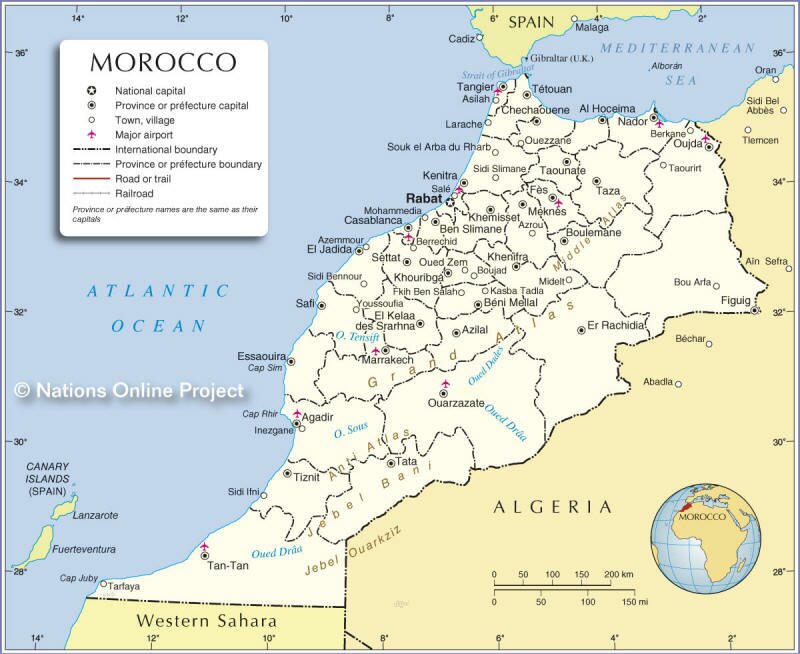
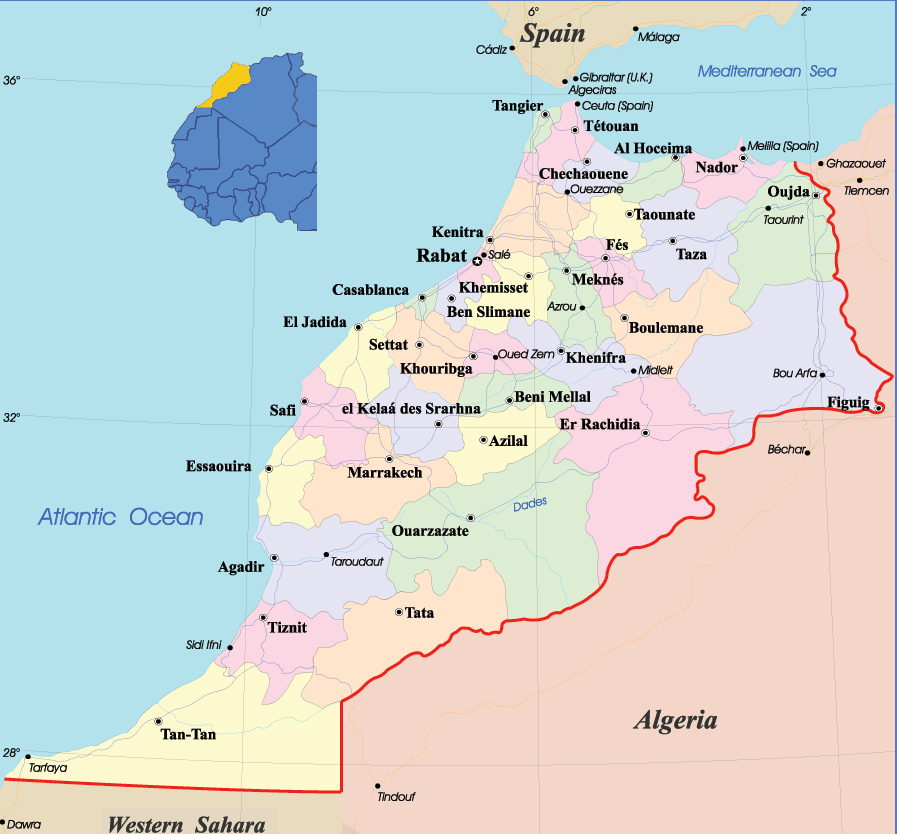
Morocco
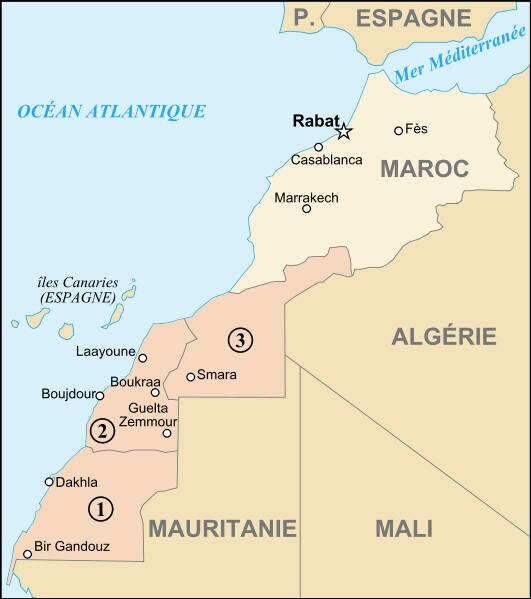
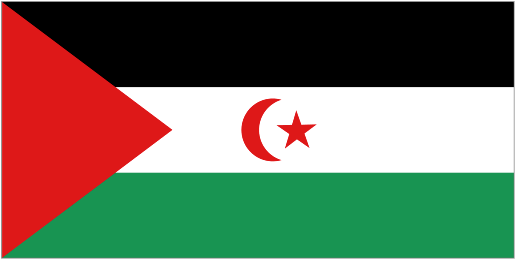
Western Sahara
|
Click on either map to see it in detail |
|
| Origin of the name Morocco |
Official name is Kingdom of Morocco, although the conventional shorten name of Morocco is used.
|
|||
|
Symbols
|
Click on each link below to learn more about the symbols.
|
|||
|
Regions
|
(Click on the map to see it in detail)
|
|||
| Language |
Morocco's official language is classical Arabic. The country's distinctive Arabic dialect is called Moroccan Arabic. Approximately 12 million (40% of the population), mostly in rural areas, speak Berber – which exists in Morocco in three different dialects (Tarifit, Tashelhiyt and Tamazight) – either as a first language or bilingually with the spoken Arabic dialect. French, which remains Morocco's unofficial second language, is taught universally and still serves as Morocco's primary language of commerce and economics. It also is widely used in education and government. About 20,000 Moroccans in the northern part of the country speak Spanish as a second language in parallel with Tarifit. English, while still far behind French and Spanish in terms of number of speakers, is rapidly becoming the third foreign language of choice among educated youth (after Arabic and French). As a result of national education reforms entering into force in late 2002, English will be taught in all public schools from the fourth year on. French however, will remain the second foreign language because of Morocco's close economic and social links with other French-speaking countries and especially France.
Source: www.wikipedia.com, US Library of Congress, www.countrystudies.com |
|||
|
History
|
Morocco has been the home of the Berbers since the second millennium B.C. In A.D. 46, Morocco was annexed by Rome as part of the province of Mauritania until the Vandals overran this portion of the declining empire in the 5th century. The Arabs invaded circa 685, bringing Islam. The Berbers joined them in invading Spain in 711, but then they revolted against the Arabs, resenting their secondary status. In 1086, Berbers took control of large areas of Moorish Spain until they were expelled in the 13th century.
The land was rarely unified and was usually ruled by small tribal states. Conflicts between Berbers and Arabs were chronic. However, when Portugal and Spain began invading Morocco, it helped to unify the land in defense. In 1660, Morocco came under the control of the Alawite dynasty. It is a sherif dynasty—descended from the prophet Muhammad—and rules Morocco to this day. European powers showed interest in colonizing the country beginning in 1840, and there were frequent clashes with the French and Spanish. Finally, in 1904, France and Spain concluded a secret agreement that divided Morocco into zones of French and Spanish influence, with France controlling almost all of Morocco and Spain controlling the small southwest portion, which became known as Spanish Sahara. Morocco grew into an even greater object of European rivalry by the turn of the century, almost leading to a European war in 1905 when Germany attempted to gain a foothold in the mineral-rich country. By the terms of the Algeciras Conference (1906), the sultan of Morocco maintained control of his lands and France's privileges were curtailed. In 1912, the sultan of Morocco, Moulay Abd al-Hafid, permitted the French protectorate status. Nationalism expanded during World War II. Sultan Muhammed V was deposed by the French in 1953 and replaced by his uncle, but nationalist agitation forced his return in 1955. In 1956, France and Spain recognized the independence and sovereignty of Morocco. At his death on Feb. 26, 1961, Muhammed V's son succeeded him as King Hassan II. In the 1990s, King Hassan promulgated “Hassanian democracy,” which allowed for significant political freedom while at the same time retaining ultimate power for the monarch. In Aug. 1999, King Hassan II died after 38 years on the throne and his son, Prince Sidi Muhammed, was crowned King Muhammed VI. Since then Muhammed VI has pledged to make the political system more open, allow freedom of expression, and support economic reform. He has also advocated giving more rights to women, a position opposed by Islamic fundamentalists. The entrenched political elite and the military have also been leery of some reform proposals. With about 20% of the population living in dire poverty, economic expansion is a prime goal. Morocco's occupation of Western Sahara (formerly Spanish Sahara) has been repeatedly criticized by the international community. In the 1970s, tens of thousands of Moroccans crossed the border into Spanish Sahara to back their government's contention that the northern part of the territory was historically part of Morocco. Spain, which had controlled the territory since 1912, withdrew in 1976, creating a power vacuum that was filled by Morocco in the north and Mauritania in the south. When Mauritania withdrew in Aug. 1979, Morocco overran the remainder of the territory. A rebel group, the Polisario Front, has fought against Morocco since 1976 for the independence of Western Sahara on behalf of the indigenous Saharawis. The Polisario and Morocco agreed in Sept. 1991 to a UN-negotiated cease-fire, which was contingent on a referendum regarding independence. For the past decade, however, Morocco has opposed the referendum. In 2002, King Muhammed VI reasserted that he “will not renounce an inch of” Western Sahara. Source: www.infoplease.com |
|||
| Government |
The country is run as a constitutional monarchy. The legal system is based on Islamic law and French and Spanish civil law systems; judicial review of legislative acts in Constitutional Chamber of Supreme Court; has not accepted compulsory ICJ jurisdiction.
The Executive Branch: Chief of state: King MOHAMED VI (since 30 July 1999), The Legislative Branch: Bicameral Parliament consists of a Chamber of Counselors (or upper house) (270 seats; members elected indirectly by local councils, professional organizations, and labor syndicates for nine-year terms; one-third of the members are elected every three years) and Chamber of Representatives (or lower house) (325 seats; 295 members elected by multi-seat constituencies and 30 from national lists of women; members elected by popular vote for five-year terms) Source: CIA World Factbook |
|||
| Economy |
Morocco's largest industry is the mining of phosphates. Other resources include copper, iron ore, lead, manganese, salt, silver, and zinc. Its second largest source of income is from nationals living abroad who transfer money to relatives living in Morocco. The country's third largest source of revenue is tourism; 7.45 million tourists visited the country in 2007.
In 2004, Morocco’s agricultural sector, including forestry and fishing, constituted 16.7 percent of gross domestic product (GDP) but employed 40 percent of the workforce. The agricultural sector is regarded as volatile, because of its vulnerability to inconsistent rainfall among other factors, and has been contracting in recent years. Morocco’s principal crops, in order of yield, are rice, sugar beets, barley, potatoes, tomatoes, and sugarcane. Other agricultural products include wheat, citrus fruits, olives, other vegetables, wine, and livestock. Morocco ranks among the world’s largest producers and exporters of cannabis, and its cultivation and sale provide the economic base for much of the population of northern Morocco. The cannabis is typically processed into hashish. This activity represents about 0.5% of Morocco's Gross Domestic Product (GDP). A UN survey estimated cannabis cultivation at about 1,340 square kilometers (515 sq mi) in Morocco's five northern provinces. This represents 10% of the total area and 27% of the arable lands of the surveyed territory and 1.5% of Morocco's total arable land. Source: www.wikipedia.com, www.countrystudies.com Weights and Measures: Metric weights and measures are used.
Monetary Unit: The dirham (DH) is a paper currency of 100 Moroccan centimes. There are coins of 1, 5, 10, and 20 Moroccan centimes and 1/2, 1, and 5 dirhams, and notes of 5, 10, 50, 100, and 200 dirhams. DH1 = $0.1021 (or $1 = DH8.70) as of October 2008. |
|||
| Geography and Climate |
Geography
Morocco is situated in the northwest corner of Africa and is over 446,000 sq km in area, which makes it slightly larger than the US state of California. The Atlantic Ocean lies to the west and the Mediterranean to the north. The land borders of Morocco to the east are with Algeria and to the south are with Mauritania. In the northwest, Morocco is separated from Spain by the narrow Straits of Gibraltar. Source: www.worldinfozone.com Climate The Rif and Atlas mountain ranges divide Morocco into two climatic zones: one that receives the westerly winds from the Atlantic and one that is influenced by the proximity of the Sahara Desert. Western and northern Morocco have a Mediterranean (subtropical) climate, with mild winters and hot, dry summers. On the Atlantic Coast, the mean temperature is 16º C (62º F) to 23º C (73º F). By contrast, the climate is more extreme in the interior, where it is subject to wide seasonal variation, with temperatures ranging from 10º C (40º F) to 27º C (81º F). The pre-Saharan south has a semiarid climate. Rainfall varies from moderate in the northwest to scanty in the south and east. The rainy seasons are April–May and October–November. Only the mountains receive rain in the summer. Because of its inconsistent rainfall, Morocco is subject to periodic droughts, which take a considerable toll on agriculture. There are eight sites in Mauritania on the World Heritage List:
|
|||
|
Population
Culture and Religion |
Population People and Ethnic Groups As of mid-2006, Morocco had an estimated total population of 33.2 million making it the third most populous Arab country, after Egypt and Sudan. Most Moroccans are Sunni Muslims of Arab, Berber, or mixed Arab-Berber stock. About three-quarters of all present-day Moroccans are of Berber descent, while Arabs form the second largest ethnic group. Most people live west of the Atlas Mountains, a range that insulates the country from the Sahara Desert. Casablanca is the center of commerce and industry and the leading port; Rabat is the seat of government; Tangier is the gateway to Morocco from Spain and also a major port; Fez is the cultural and religious center; and Marrakech is a major tourist center. Source: www.wikipedia.com, US Library of Congress, www.countrystudies.com Culture Morocco is an ethnically diverse country with a rich culture and civilization. Through Moroccan history, Morocco hosted many people coming from East (Phoenicians, Carthaginians, Jews and Arabs), South (Sub-Saharan Africans) and North (Romans, Vandals, Andalusians (including Moors and Jews)). All those civilizations have had an impact on the social structure of Morocco. It conceived various forms of beliefs, from paganism, Judaism, and Christianity to Islam. Each region possesses its own specificities, thus contributing to the national culture and to the legacy of civilization. Morocco has set among its top priorities the protection of its diverse legacy and the preservation of its cultural heritage. Culturally speaking, Morocco has always been successful in combining its Berber, Jewish and Arabic cultural heritage with external influences such as the French and the Spanish and, during the last decades, the Anglo-American lifestyles. Source: www.wikipedia.com Religion Islam is the official religion of Morocco. Muslims constitute 99% of the population; about 90% of Muslims adhere to Sunni Islam. The population also includes very small numbers of Christians and Jews, who are able to worship without restriction. Source: www.countrystudies.com |
|||
| Fauna and Flora |
The range of plants is influenced by specific habitats: Seashores – where you can find sand-tolerant species such as sea holly and sea stocks. Lowland hills – which are covered by dense, shrubby species known as maquis, lower-lying, more grazed areas, known as garrigue and more open areas with abundant aromatic herbs and shrubs. Mountain slopes – dominated by ash, oak, atlantic cedar and juniper forest. Steppeland – south of the Atlas Mountains temperatures rise sharply and the forests are replaced by sparse grass plains. Desert fringe – flowers such as dwarf varieties of asphodels, daisies and statice bloom after the infrequent spring showers.
Larger animal life in Morocco is dominated by the extensive nomadic hers of goats, sheep and camels which use the most inaccessible and barren patches of wilderness as seasonal grazing areas. One of the most impressive of the wild mammals is the Barbary ape which is actually a Macaque monkey. These frequent the cedar forests and can be seen on the ground foraging for food in the glades along with wild boar and red fox. The majority of the smaller mammals in Morocco live south of the Atlas ranges. Larger herbivores include the Edmi gazelle and the rare Addax antelope. Smaller animals include the desert hedgehog and the jerboa. An oddity, found in the High Atlas is the African elephant shrew – like a small mouse with an elephant trunk. Reptiles are widespread and include the blue and green-eyed lizard, the chameleon, the Spanish wall lizard and the Moorish gecko. Snakes include the horseshoe snake and the Montepelier snake. The deserts harbor the Algerian sand lizard and the Berber skink. Increasingly rare amphibians include the green frog, the western marsh frog, the Berber toad and the Mauritanian toad. Source: Rough Guides Morocco, October 2007 |
|||
| Environment |
Livestock overgrazing, clearing of forests for fuel, and poor soil conservation practices have led to soil erosion and desertification. The nation has about 30 cu km of renewable water resources. Ninety-two percent is used in farming and 3% for industrial activity. About 98% of the nation's cities have pure water, but only 56% of rural dwellers have the same access. Morocco's cities produce about 2.4 million tons of solid waste per year. The nation's environment is further challenged by pesticides, insect infestation, and accidental oil spills. Destruction of wildlife has occurred on a large scale, despite strict laws regulating hunting and fishing. Moreover, the drainage of coastal marshlands to irrigate cultivated land has significantly reduced the numbers of crested coots, purple herons, and marbled and white-headed ducks. The elimination of living areas for Morocco's wildlife threatens 18 of the nation's mammal species and 11 bird species. About 182 plant species are also endangered.
Source: Encyclopedia of the Nations |
|||

|
We thank our West Africa Expedition Sponsors Please visit their websites
|




|
Contact us for information regarding sponsorship opportunities.
Join the Virtual Classroom. Complete the free registration form for your classroom today. Support the expeditions. Your donation will help to continue the research, documentation and Virtual Classroom web site presentation of these wonderful cultures and experiences to the broadest possible audience. To find out how you can help, please follow this link to our Helping Hand page. Thank you, now it's time to explore!
|